Irohajima
This page was machine-translated. Read the original (Nederlands)
In the end I wasn’t lying all that comfortably in Yobuko after all. This harbour wall had the same old problem: at high water there’s only 5 to 10 centimetres of quay left above the surface. Your fender boards and fenders then happily pop up over the edge, and the boat’s delicate painted waterline ends up grinding against the concrete. So instead of scooting off on the electric scooter to the octopus sellers a little further along the next day, I got the hell out of there. Shame, I’d have liked to stay a bit longer. Next on the list was the bay we’d already spotted on the drive from Hirado to Fukuoka. To get to the yard back then we’d driven all the way around the island of Fukushima, partly in search of a lunch spot. Sadly they were all closed, but at least we saw the whole island! And so, the bay to the north-east of Fukushima. Once again there was hardly any wind and the whole passage had to be done under engine. 3, maybe 5 knots, all of it a bit of thermal breeze that’s no use to anyone.
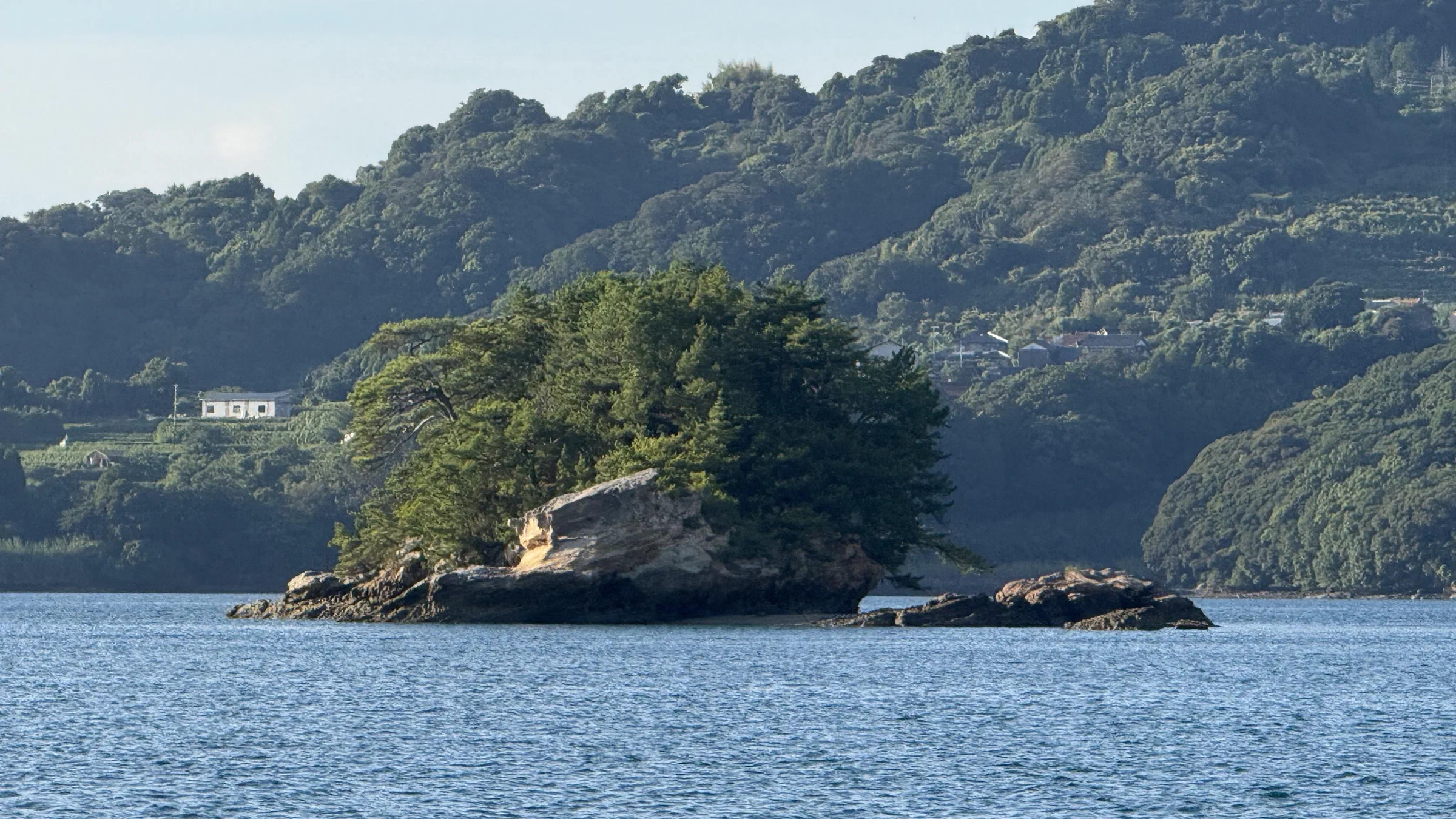
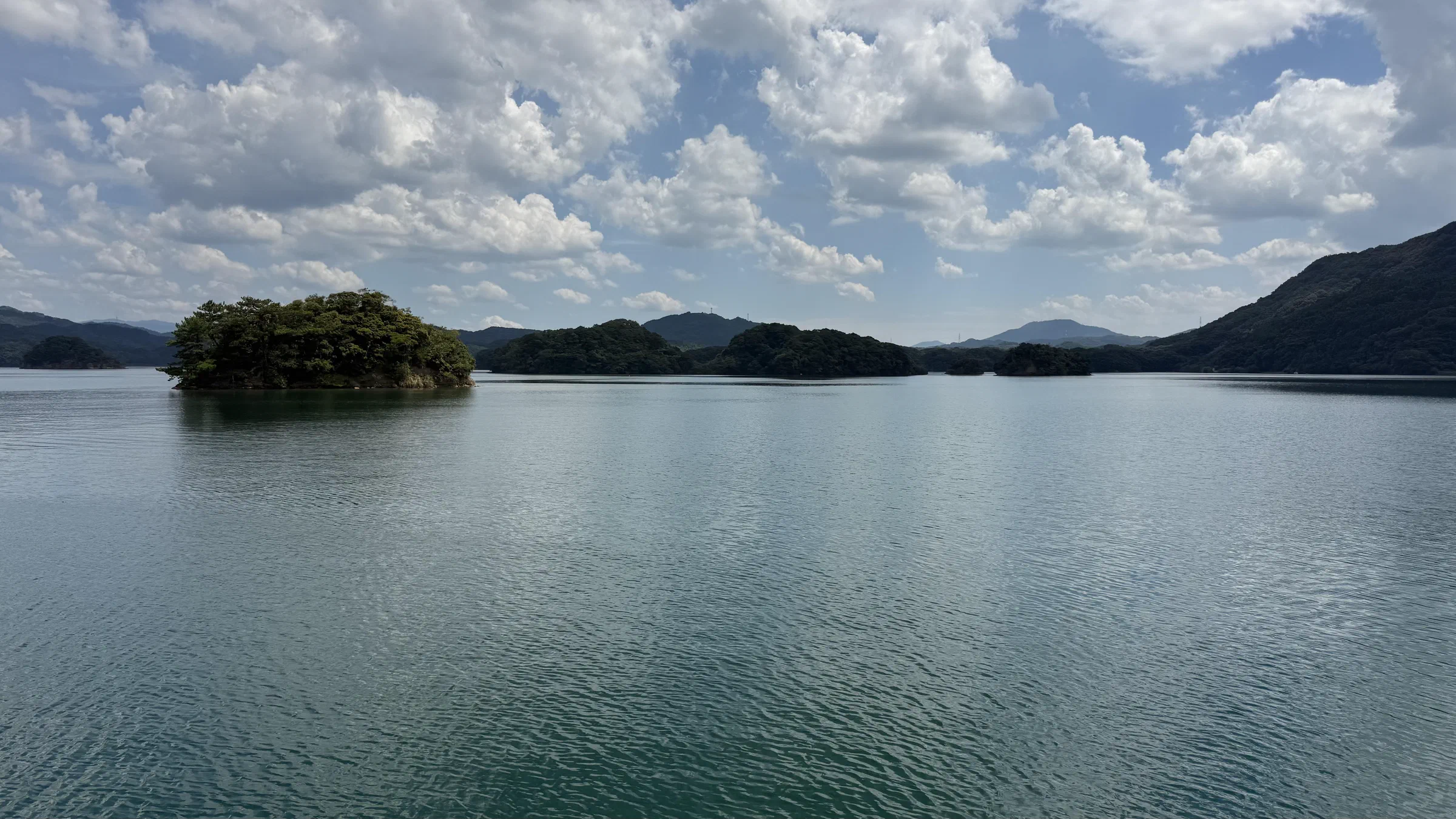
On the way I could understand why even Kirk has never visited this bay. You turn into a big bay that isn’t particularly attractive. A huge coal-fired power station with two enormous chimneys, followed by the biggest nuclear power plant in western Japan. Then some shipyards and other industry. So you think: why on earth would I keep going? Even I had my doubts. Good thing I did. Round two corners and suddenly your jaw drops. Anchored right in the middle of a huge number of little islands, each one cuter than the last. All covered in what we’d call “Japanese” trees: gnarled, not very tall, but really beautiful. And then there are all the rocks, which look different every hour depending on the light. I think it’s the most beautiful anchorage I’ve ever been in. And super sheltered too: the bay and the islands keep the swell right down, and the high hills around it take the edge off the wind. You do see a few signs of habitation: a little hamlet, the edge of a boatyard, a hotel (closed) with a beach. Some power lines way off in the distance. Apart from the usual “village alarm” (a little tune is played at 07:00, 12:00, 17:00 and 18:00) you hear absolutely nothing.
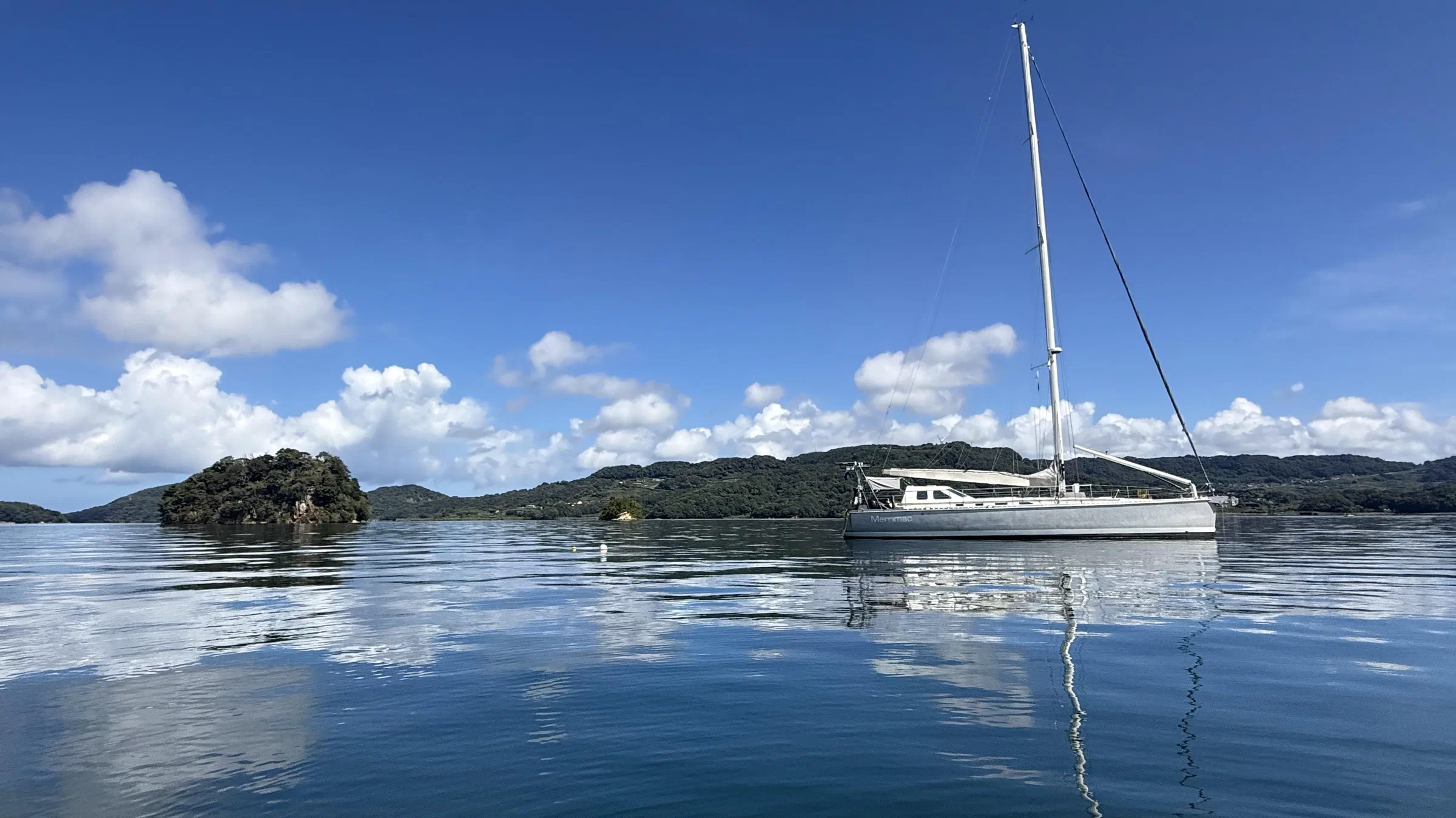
It turned out the spot I’d picked even has a “scenic spot” symbol on Google Maps, see Irohajima. Let me quote one of the reviews:
*The Iroha Islands (Irohajima) is the collective name for the countless uninhabited islands in the sea between Hizen-cho (Karatsu City, Saga Prefecture) and Fukushima-cho (Matsuura City, Nagasaki Prefecture), in the eastern part of Imari Bay. The name is sometimes written as Iroha-jima. There are said to be 48 islands; the name “Iroha Islands” derives from the 48 characters of the Japanese syllabary (the “Iroha”). The main islands include Benten-jima, Matsushima and Takenoko-jima.
Number of islands: 48 (depending on how you define the group). Islands on the Saga Prefecture side are sometimes, but not always, counted as part of the Iroha Islands.*
Administratively they all fall under Matsuura City (Nagasaki Prefecture), but islands on the Saga Prefecture side, such as Shimayama-jima, are sometimes included in the group as well. Because of the splendid views over the archipelago from the lookout points in Mitsukoshi Park (Hizen-cho, Karatsu City) and Oyama Park (Fukushima-cho, Matsuura City), the islands are frequently mentioned in tourist guides for Saga Prefecture and the cities of Karatsu and Matsuura. Legend has it that the famous Buddhist monk Kobo Daishi was so overwhelmed by the breathtaking scenery that he dropped his brush while painting. The area is part of Genkai Quasi-National Park.
Because the islands lie within a bay, the surrounding water is calm, which makes the area a popular location for pearl farming and a well-known spot for wild oysters.
After a day of resting and being on my own, it suddenly dawns on me how much I needed this. Really badly, in fact. I have been on the go for 12 months now (with two spells of a month at home in between), and since Panama at the beginning of May it was first 9,000 miles across the Pacific and then a whole month of new impressions and a different spot every two or three days. I realise there’s no need for any of that now, and decide to stay until I’ve had enough.
The next day I see that 3 kilometres away there’s a little harbour with a BBQ place run by the local fishermen. Only open at weekends, mind you. You buy a bag of oysters, watch how it’s done (they show you) and then you cook them yourself on the BBQ. That sounds absolutely brilliant. On Saturday I finally think: still no energy, but I’ll at least get the dinghy ready so I’m all set for tomorrow. Then I grab the petrol can. Erm, that’s dumb: the vent cap has been open since the San Blas, so all the petrol has evaporated! Well, that’s not getting me ashore. In the end I cook my Mexican bean stew, which is also tasty. Only on the third day does the penny drop.
I tackle a few boat jobs and get to concentrate nicely on the open source software I’m working on. Unfortunately there are also some “management” issues going on there. Thanks to AI it has suddenly become easier to write software than to judge whether it actually “fits” into the bigger picture, and all sorts of irritations are cropping up between (other) developers. As one of the founders of Signal K I’m asked to see whether we can smooth over a row. I’m the neutral party here, but I do get annoyed with a Finnish developer who isn’t exactly very flexible. As the other Finnish co-founder put it:
How does an engineer bend a steel rail? The wiser one gives way.
Explanation
In other words, an engineer is dumber and less flexible than a steel rail…
The good news is that as you get older you learn to take this sort of thing more in your stride, so I don’t let it spoil my mood. Did I mention how beautiful it is here? I’m completely unwinding…
Meanwhile an open boat with 3 men, two of them in orange life jackets, comes past. They point at the flag and ask “America?” No, “Oranda”. Jaws drop. Then they ask another question, which I suspect is whether I’ve sailed all the way here. Yes, “Hai”, of course. Now they’re completely flabbergasted and start bowing profusely and going “ooooohhhh”. Yes, sailing around the world is something that 100% doesn’t fit into the Japanese way of seeing things, where you’re supposed to conform, adapt and not stand out too much. But they do think it’s great when you actually do it. In the little eateries too, where they sometimes look down on you a bit at first (you are, after all, just a foreigner, a “Gajin”), they come round completely when Marion said I had come by sailing boat, all the way from “Oranda” (via Olanda, Holland). On a “Yotto”, the Japanese word for sailing boat. One guess where they borrowed that one from.
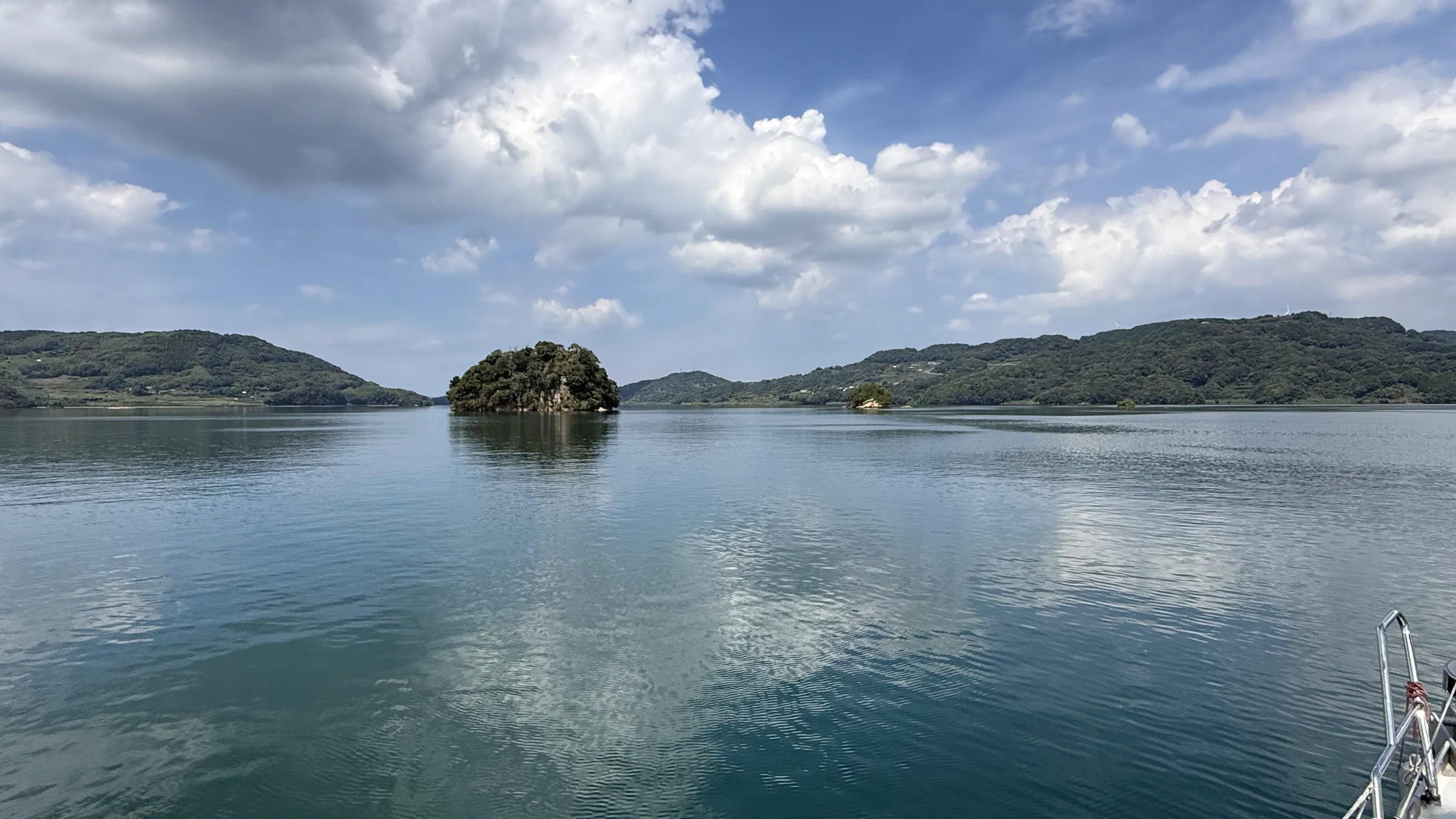
Only after a week in this bay do I finally move on to the next spot. And mainly because there’s a change in the weather on the way; if I didn’t go on Thursday (3 September) I’d be stuck for another week, and without transport to the shore that starts to feel like a long time. On Wednesday I confer with Kirk and Mari from Konpira, and in the end on Thursday I sail in one go to Kamigoto Umi sea station on Nakidori, the largest island of the Goto Islands. But more about that next time.
Comments