Arriving in Suriname by sailing yacht (2025 edition)
This page was machine-translated. Read the original (Nederlands)
I’d already heard that the arrival procedure for Suriname had changed last year, but I hadn’t expected it to have gone this digital, let alone that it would actually work! For those coming after me, here are a few tips on the what and the how.
In chronological order it goes roughly like this (each step is explained in more detail below):
- Apply for an e-visa online (you can do this well in advance)
- Sail to Suriname
- On the way or on arrival, fill in the online forms for customs and the maritime police.
- Pick up a mooring or drop the anchor at Harbour Resort Domburg
- Go for a swim in the pool
- Arrange to meet Erik, who will help you with the rest of the procedure
- On the next working day, or well, this is Suriname, the day after, go with taxi driver Harry to the place where you have to report with all the passports, the e-visas and a crew list.
- Done!
So in total you have to deal with three authorities (websites), and for the MAS you even have to fill in three forms online. Since customs only opens up seven days in advance, the only way to do this on board is via Starlink. If you don’t have Starlink, you can also use the WiFi at the Harbour Resort.
1. e-visa
You apply for an e-visa online at https://suriname.vfsevisa.com/
Watch out: there are other providers that fill in the real site for you behind the scenes but relieve you of some extra “doekoe” (Surinamese for dough) in the process. A “single entry” tourist visa shouldn’t cost more than €58 per person. It lets you stay for 30 days, extendable by another month.
2. Sailing
If, for whatever reason that makes sense to you, you don’t have a PredictWind subscription: head for the border between Brazil and French Guiana, and wait until you first get a southerly-setting current (1 kn) and then a north-westerly one (3 kn). That’s the tip we were given back in the day. Every sensible sailor ends up using PredictWind towards the end of their trip, so you might as well start right away. From 7 days out, PredictWind also takes the current into account in its “sail routing” option. You’ll still sail roughly the same route, but you’ll have a better idea of why it’s telling you to take some odd dogleg here or there. If you’re sailing from Mindelo, this won’t be factored in at the start, so favour the southerly route a bit for the first few days.
Stay away from the coast as long as possible; that’s where most of the fishermen are. In the weeks before Christmas it isn’t too bad, as most of them have used up their fishing days by then and are tied up ashore. Further out at sea, every fisherman at least has a light on. They were easy to identify and easy to steer clear of.
In the end we came in on a course of 240 to the fairway buoy. Since there’s quite a bit of current (2+ knots) on the river, you’ll want to go upriver on the flood. Also keep an eye on your depth and the narrow channel. At +2 m of tide we found a minimum depth of about 4.5 m, and 6.7 m in the channel. Call MAS (pronounced as one word) on VHF channel 16; I got no answer on channel 12. Around high water the big ships first go out and then come in. So from 2 hours before high water you can expect outbound traffic. We had only just cleared the narrowest stretch when we met the first big ship. She was 148 m with a 7 m draught, so she had to stick to the channel. She duly called us up to check that we understood this (of course, we’d already moved over…)
Don’t sail on the east side of the green buoys, especially at the end of the narrowest section. There’s an entire little island there that isn’t on the chart.
When you reach the Commewijne, don’t go too far to starboard; there are stakes with fishing nets all over the place. The same goes for the fork itself. Next you sail past Paramaribo; off Paramaribo you can keep to the right-hand side for the best view. Then pass under the “Bosje Brug” (plenty of clearance, 52 m) and carry on to Domburg.
3. Filling in forms on the way
On the way you can apply for the e-visas (if you hadn’t done so already). And from 7 days before arrival you can fill in the customs forms at https://icf.sr/ and, if you like, the MAS (Maritime Authority Suriname) forms at https://mas.sr/notice_of_arrival, but those can also be done up to two days after arrival!
If you didn’t manage it all on the way, don’t worry, this isn’t the USA or North Korea; you’ll just do it at your leisure over a coffee or a beer in the restaurant (see step 4.)
4. Mooring up
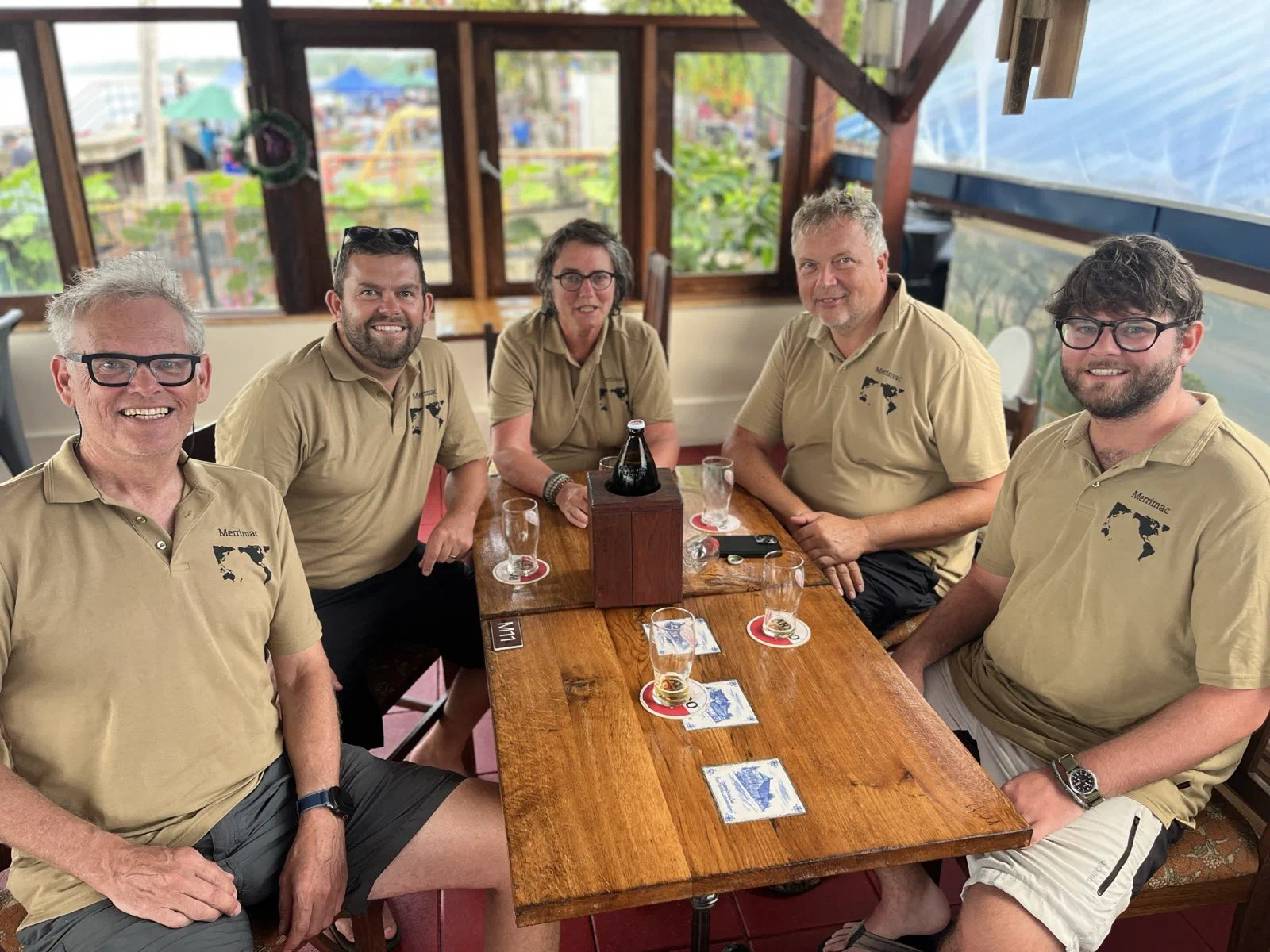
In theory you can choose between two places to tie up. At first glance Waterland looks very appealing because they have jetties where you can step straight ashore. However, it’s in a resort where the restaurant is only open 1 or 2 days a week (Saturday/Sunday) and there’s absolutely nothing behind the resort. Not recommended without a rental car. Domburg is the better choice in my opinion. Here you lie on a mooring (€15 per day) or at anchor (€10 per day if you want to use the facilities.) There’s a private dinghy dock (locked with a key), and for the fee you can use the toilets, showers and the simple swimming pool. You can also use the washing machine for €5. All this makes up “Harbour Resort Domburg”, which also includes “Restaurant River Breeze”. You can get perfectly decent simple food here – think pizza, pasta, burgers, satay, dish of the day etc. – and drink a very fine Djogo Parbo Bier with a bitterbal. All of it right next to Domburg’s tiny town centre: a few simple bars, (takeaway) restaurants, Chinese supermarkets with a surprisingly wide range, a petrol station, ATMs, and one block further on another petrol station-cum-hardware store where you can buy SIM cards and e-top-ups. Erik, restaurant owner-cum-tour guide-cum-harbourmaster, was already waiting for us when we arrived. He can point you to anything you need and helps you with the formalities. See also https://marinasuriname.com
5. Swimming
The first thing we did after arriving was head ashore, change, and have a nice swim. It was heavenly.
6. Erik
If you haven’t spoken to him yet, now’s the time to go and find Erik, an Amsterdammer with his heart in the right place who has been knocking around Suriname for 30 years. Together you’ll sort it all out. In our case he arranged a trip into the interior for the crew and, for the skipper, his regular taxi driver Harry.
7. Reporting to the police
Harry picks up the captain and inspects his/her outfit. You’re expected to show the authorities due respect, you see. Proper shoes (as in: no flip-flops), long trousers and a freshly washed shirt. On the way you’re treated to juicy stories about Suriname, we stop for a coffee, a sandwich on the way back, no stress. At what feels to you like a random moment, we turn right somewhere near the port and Harry takes the captain to the right door, which says absolutely nothing about you needing to be there. You just have to know. I was back on the boat within 3 hours, including 2 x 45 minutes of driving and 2 shops (one for Harry to get a new phone and one for me to see what kind of PVC they have at https://kuldipsingh.net ). The whole taxi ride cost €35. Before you go to the police, you really do need to have your e-visas sorted by now. I’d neatly printed them out and brought a crew list, but (a) I’d left the visa printouts behind after all and (b) I hadn’t copied the visa numbers starting with W onto the crew list, so I just added all the numbers to the crew list there in the office. No stress sir, it’ll be fine. In other words, people here are still simply human, and one little mistake doesn’t immediately mean game over and start again.
So to sum up: these days it’s really not too bad, and you no longer have to take the whole crew round all the little offices in a taxi. Which is also a bit of a shame; it was quite a palaver and took you from 9 till 2, but it did have a certain charm.
To clear out, you go back to the same police officer at the container terminal with a new crew list and the passports. Just the skipper is fine, and I was allowed to do it on the Friday even though I was leaving on the Monday. The opening hours are a bit vague, I’d guess 9 to 5, but on our Friday afternoon there was a national commemoration of a family tragedy, so they were closed. Luckily I’d already cleared out myself that morning, so it all went fine. Erik then gives you an exit document that you can show to customs in the next country to prove that you left Suriname properly.
Below you can download a sample crew list and adapt it as you see fit.
i
Comments