Ryfylke, Norway
This page was machine-translated. Read the original (Nederlands)
Phew, this is another first for the year – a report written almost live! Last Tuesday we left the anchorage south of Lerwick nice and early again, around 6 o’clock. It was drizzly, dull and cold once more. There was, however, a south-westerly force 5 gusting 6. If you want to head east-south-east that’s perfect: the wind is on the quarter and the sails see it as if it were coming from abeam. That’s because the boat speed of 9 to 10 knots shifts the apparent wind direction. Perhaps another reason why you find so many fairly technical people among sailors – you need to do vector arithmetic in your head to predict the effects, and true arts types may find that a bit more of a struggle.
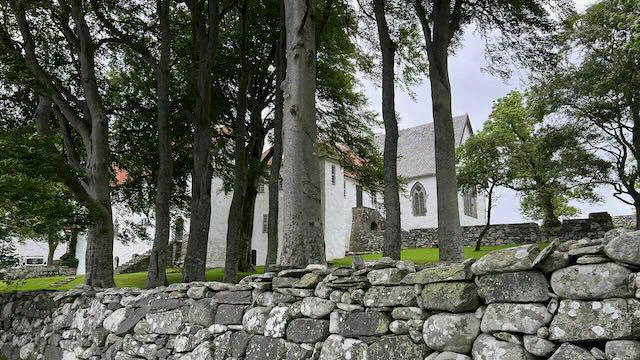
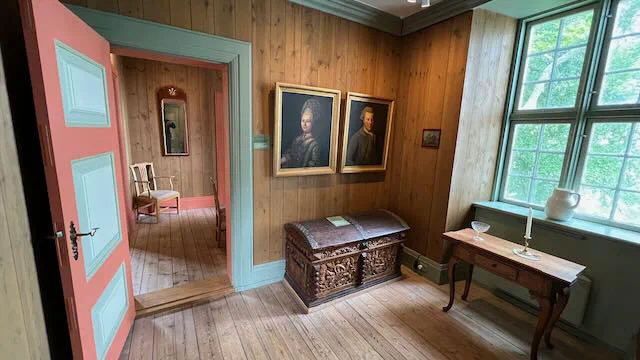
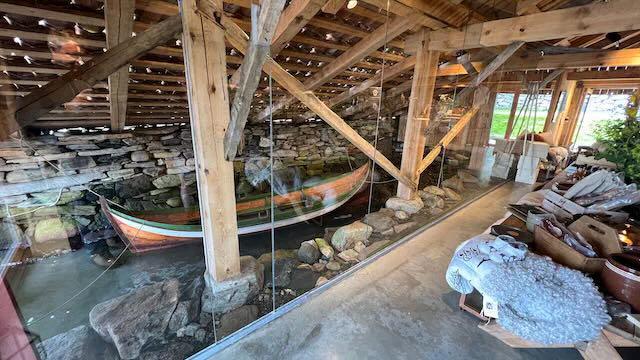
Anyway, the crossing went smoothly and wasn’t too busy. Ella took the first watch again and I relieved her around 1 a.m. Ella can stand a watch in the sense of keeping an eye on things, but changing the sail plan isn’t really her department. Fortunately, once again there was no need to wake me. Not that it would have mattered much – on a first night like that you’re not really tired enough to sleep so early anyway. So I arrived in Norway in the morning with a rather sleepy head. The boat was sailing beautifully and the wind, contrary to the forecast, kept up nicely, so we were faster than the passage plan we’d worked out beforehand. By 9 o’clock we were already tied up at a little jetty by a restaurant on the island of Mosterøy. It was an extension of a municipal pontoon, and according to Havneguiden 3 it was no problem to moor there. Still, better ask at reception. No, no problem at all – there’s just no water and no shore power. Well, we still have Dutch water in the main tank and plenty of solar panels, so we didn’t need either. A quick nap before lunch. By then the weather had switched from Scottish to Norwegian. The temperature quickly rose to 18 degrees, a phenomenon unseen by us this month! The hotel is called Utstein Kloster Hotel, so we went to have a look at the Uitstein Kloster. It’s the only pre-Reformation monastery still standing in Norway, so rather special for them. It turned out not to be too far away, and was a nice introduction to how different Norway is from Scotland. Much greener, conifers and deciduous trees, vegetation, different birds (actually just like at home) and a different style of house building. What’s more, everything is almost scarily neat and clean. And, a slightly different price level. A small 200g cheese we bought in a little shop next to the monastery turned out to cost 12 euros. Luckily it was delicious!
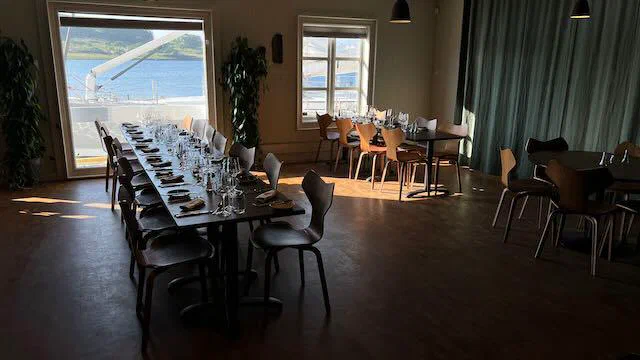
That evening we ate in the restaurant, having booked a table. It was all a bit vague how that worked; I didn’t get much more out of them than “yes, that should be fine”. We’d see. Well, the wine was delicious (and expensive). There was no choice of food: a set three-course menu with a halibut ceviche followed by lamb and a lovely dessert. Very nice indeed. With a bit of questioning the truth came out: outside the (short) summer season they mostly host business conferences and training courses. Stepping outside, we were straight back on board, and enjoyed another bottle of wine we’d bought in England on the foredeck.
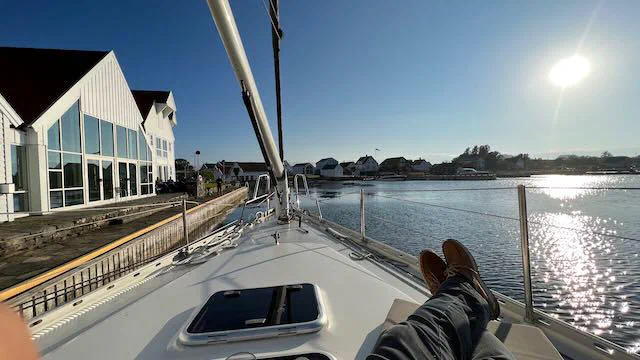
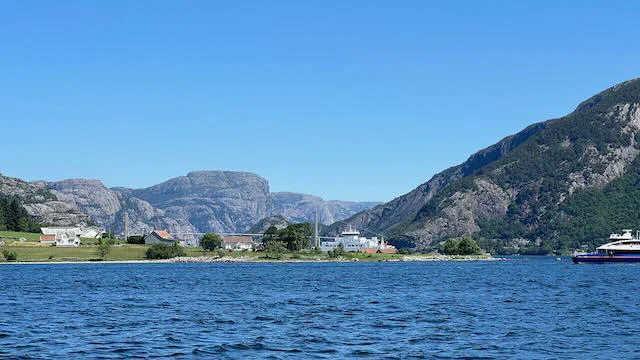
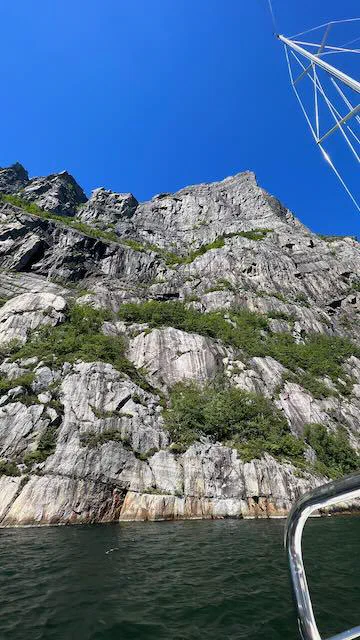
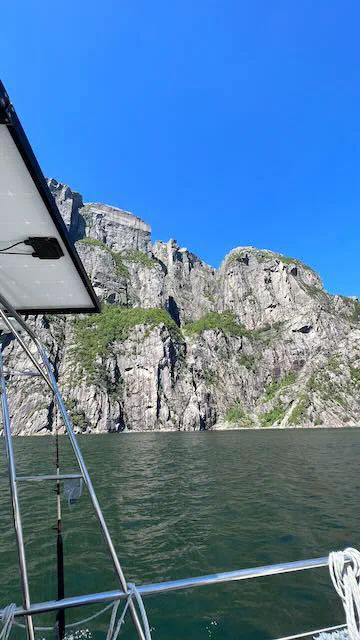
The next day was the only one in the coming days that all the weather services described as sunny, so we shot off into the fjords like a rocket, heading for one of Norway’s biggest tourist attractions: the Preikestolen (the Pulpit). A square slab of rock jutting out of the mountainside 604 metres above the boat. It overhangs the Lysefjord, which in turn is a branch of another fjord. So it was still 4-5 hours of motoring: in the fjords the wind is practically always on the nose or dead astern, because it follows the fjord. It did indeed turn out to be a glorious day with hardly a cloud. We motored through the fjord open-mouthed, each rock face more impressive than the last.
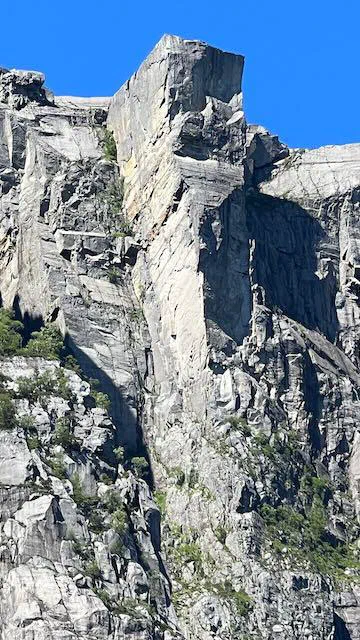
But you can’t anchor in a three-hundred-metre-deep fjord, and the spots we’d passed didn’t look very appealing. So back out of the Lysefjord, and out came Havneguiden 3 and the RCC Norway. The latter mentioned a fine little anchorage that wasn’t in the Havneguiden – how odd. When we got there we immediately understood why: very idyllic, but far too small to anchor in – especially since the owners had strategically laid a few privat mooring buoys, and the even more sheltered little cove was protected against (sailing boat) intruders by a power cable strung 4 m high across the entrance. Onwards then, and after rejecting another 2 spots we’re now lying in the natural harbour of Uskjo. A typically Scandinavian spot. A natural harbour sheltered almost all the way round, 360 degrees, with little jetties everywhere and places to moor to the shore. All holiday cottages belonging to people from Stavanger. On fine days it’s a lively place. To our surprise the only mooring buoy (which according to the RCC is available to visitors, so not private) was still free. Quickly picked it up and we’re nicely settled again. Norwegians aren’t keen on anchoring without also tying up to a rock. After watching the goings-on here for 2 days we can see why. Maybe it’s because the bays are mostly small, with limited spots of good holding at suitable depths, but everyone around us anchoring “on the swing” (as they call ordinary anchoring here) lets out far too little chain. So at the very first wind shift the anchor breaks out and they start dragging. Most of the boats are motorboats, from little ones to big ones. Nearly all of them fast, so you can cover the great distances here more quickly. And with an overhanging bow, so you can lie to a stern anchor with the bow to the rock and simply step ashore. The sailing boats tend to anchor briefly for lunch or drinks and are gone again after a few hours.
Finally, we witnessed an anchor story here involving one of the sailing boats. A neat, sleek, brand-new Grand Soleil (a boat for very respectable people, as we’d say back home) with two couples on board wanted to leave after lunch. One gentleman behind the enormous wheel, the other hauling up the anchor. Unfortunately a power cable came up with it. Whether it was or still is live we don’t know, but either way you can’t get the anchor all the way up with the windlass. The solution is to pass a line around the cable and then lower the anchor. Motor forward a little, anchor fully up, then let the line slip. Apparently these gentlemen hadn’t heard of that, because after 10 minutes of fiddling they had come dangerously close, as the helmsman had also gone forward and left the engine in ahead. After some urging, one of the ladies was willing to take the helm after all. Next came a boathook. That soon proved unhelpful: it’s hard to hold up that cable by hand, it’s pretty heavy. Still, they managed to free the anchor. But now, how do you get that heavy cable off your boathook? Out of the frying pan into the fire. So let go of the boathook then. Luckily for them, the acceleration freed it and it floated back up. Now just reverse (?) towards the boathook, because from the bow of such a high-sided boat you can’t reach it. Anyway, Ella and I kept a straight face – it all happened 20 m from us – but inwardly we found it very funny. It could happen to anyone, mind you, but the best entertainment is schadenfreude…
So much for the touristy adventures; we’re now fully up to date. Tomorrow on to Stavanger. We’ll stay around this area for a while, where you can sail in sheltered waters whatever the wind, until the wind out at sea veers to something favourable so we can carry on down the coast. For the time being it’s southerly at sea, so right on the nose, and we don’t fancy that.
Last minute: it’s just started raining. The bay is emptying…
Comments